
AI Engineering
NVIDIA’s Agentic AI Stack for Industrial AI 5.0

How NIM, NeMo, and Blueprints are turning the human-centric factory from a research concept into deployable infrastructure. Here is what that means for engineers building it.
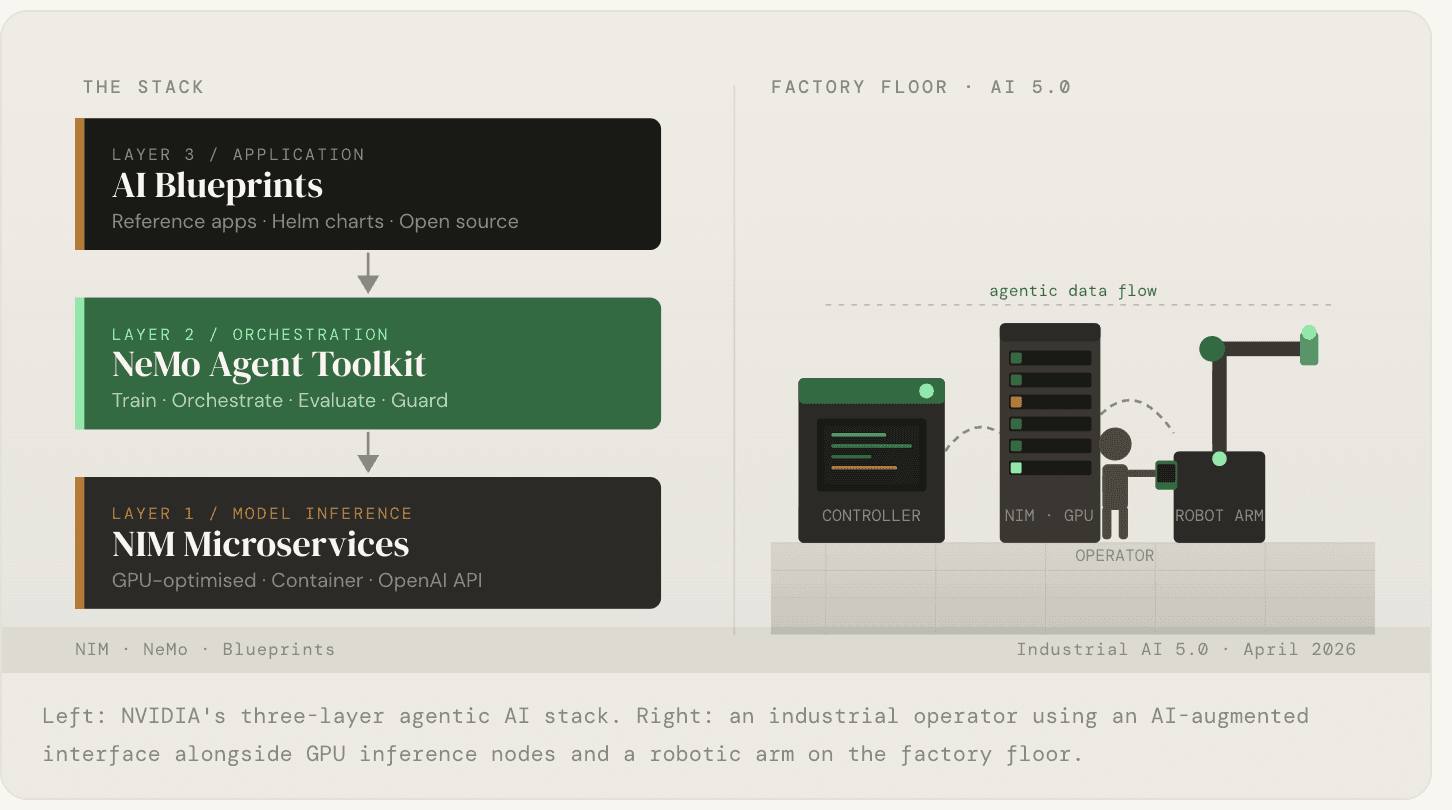
Let me start with a quick confession. When I first heard the term Industry 5.0, I rolled my eyes a little. It sounded like a marketing repackage of Industry 4.0, which itself was still being rolled out in most factories. But after spending time with the research and, more importantly, with NVIDIA's recent stack of tools built around agentic AI, I think something genuinely different is happening, and it is worth explaining clearly.
This post is aimed at both technical and non-technical readers. If you're an engineer, you'll find architectural detail and links to actual code. If you're a leader or strategist, the "what does this actually do in a factory" framing should land too. Let's go.
What is Industry 5.0, Really?
Industry 4.0 was about connecting machines to data. Smart sensors. IoT. Cloud dashboards. The goal was efficiency through visibility. And it worked, up to a point. But as factories became more automated, a new problem emerged: the systems became optimised for throughput, not for the humans working within them.
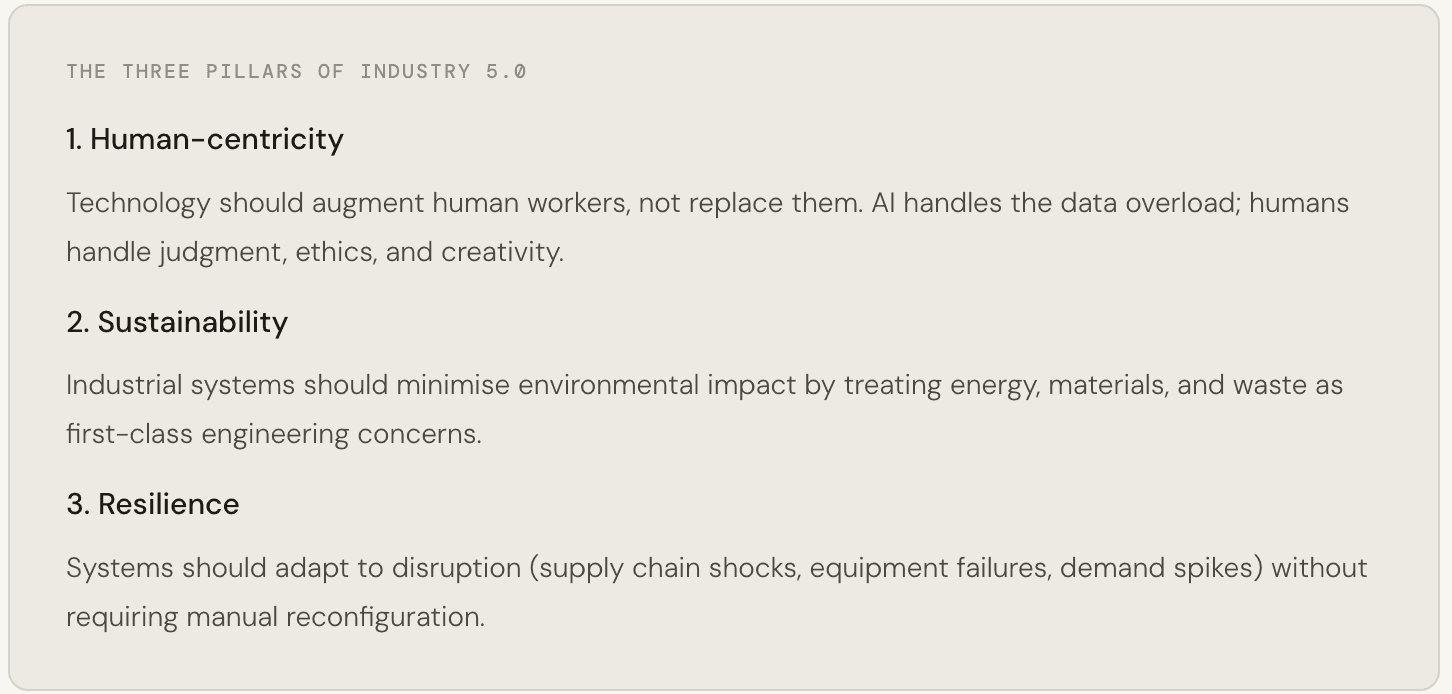
Industry 5.0 flips this. It's a framework, formalized by the European Commission in 2021, built around three principles:
The market numbers back up that this isn't just academic. The Industry 5.0 technology market was valued at over USD 51.5 billion in 2023 and is growing at over 31% annually.[1] The question is no longer whether this transition happens, but how.
The answer, increasingly, is agentic AI.
What is Agentic AI? (And Why Does it Matter for Factories?)
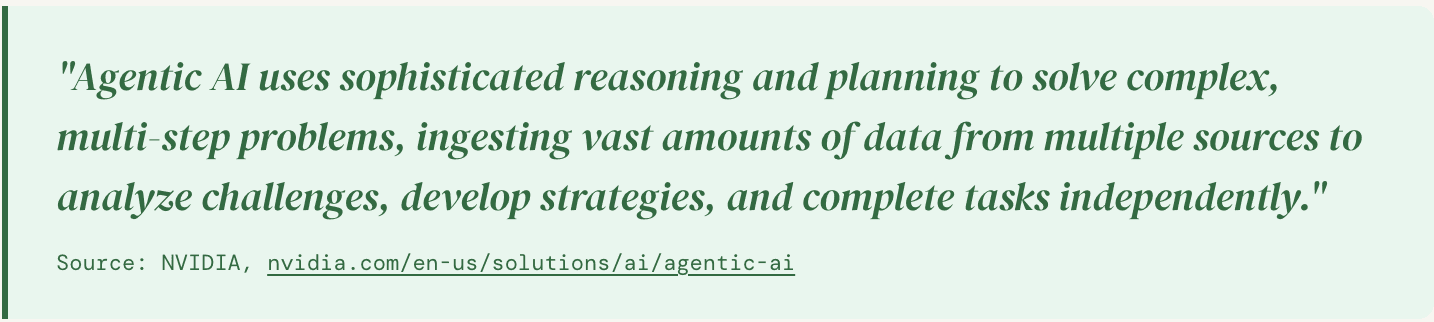
Traditional AI tools are reactive. You give them a prompt, they give you an output. Useful, but limited. An agentic AI system is different: it can reason through a problem, decide which tools to use, take a sequence of actions, and loop back to check its own work. Think less "chatbot" and more "digital coworker who can actually do things."
In an industrial setting, this matters enormously. A traditional dashboard tells you that a conveyor motor's temperature is rising. An agentic system notices the same reading, cross-references it with historical maintenance logs, checks the spare parts inventory, and creates a work order before the motor fails, all while notifying the shift supervisor with a plain-language explanation.
The research literature supports this framing. A 2025 arXiv paper on hybrid agentic AI in smart manufacturing describes a layered system where LLM-based agents handle high-level reasoning and planning, while smaller, faster models handle domain-specific tasks closer to the hardware.[2] This is not a future architecture. It is the architecture NVIDIA is shipping today.
The NVIDIA Stack: Three Layers, One System
NVIDIA's agentic AI offering is not a single product. It is a stack of composable layers. Here's how they fit together, in plain terms:
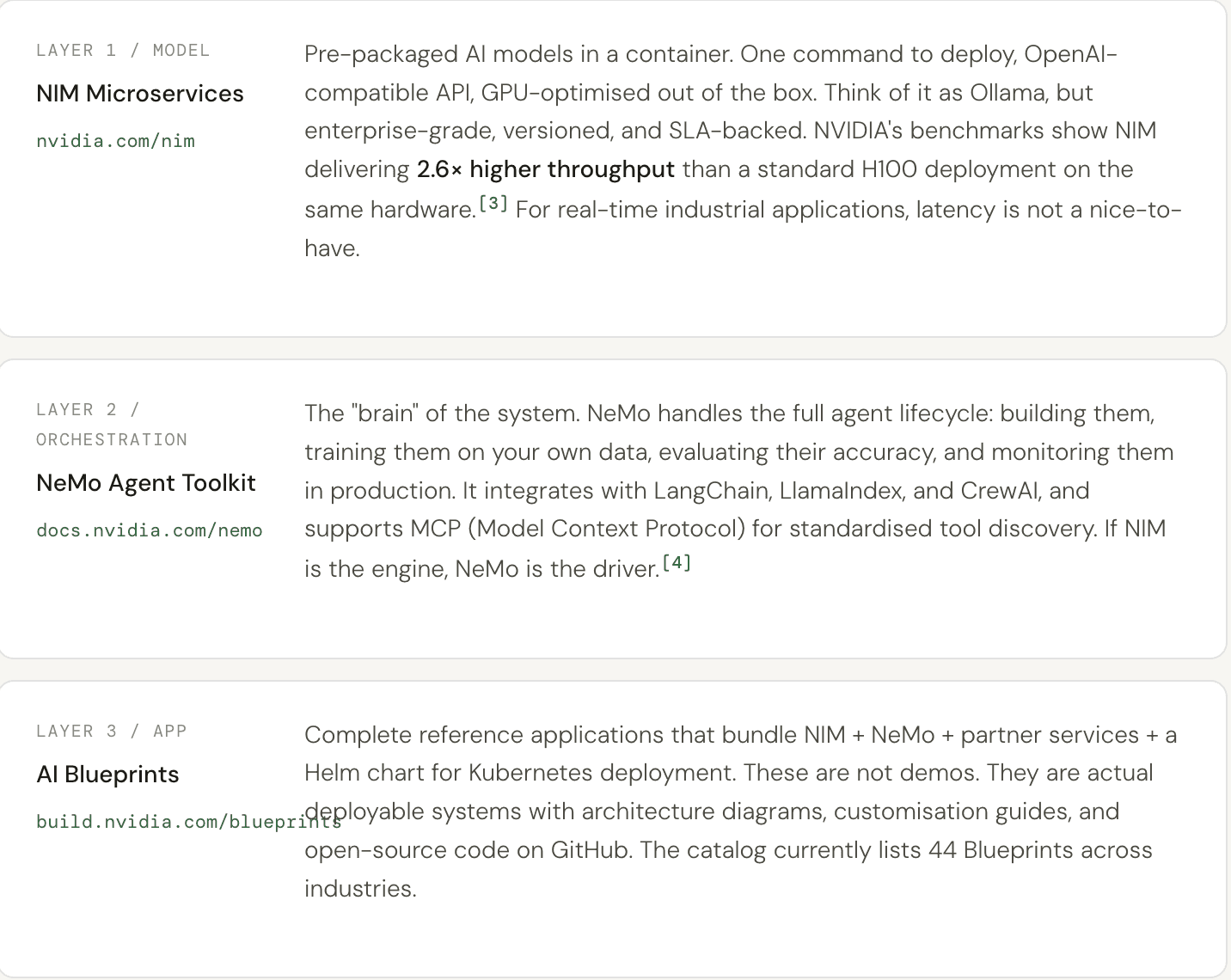
The three layers are designed to be adopted independently or together. You can run NIM endpoints and plug them into your existing LangChain agent. Or you can adopt a Blueprint and get the whole thing pre-integrated. The design choice reflects a pragmatic understanding of where most enterprises actually are in their AI journey.
Four Blueprints That Show What's Possible
Rather than describing the stack abstractly, let's look at four Blueprints that are directly relevant to Industrial AI 5.0 use cases. Each is open-source, launchable from NVIDIA's developer portal, and backed by real production deployments.
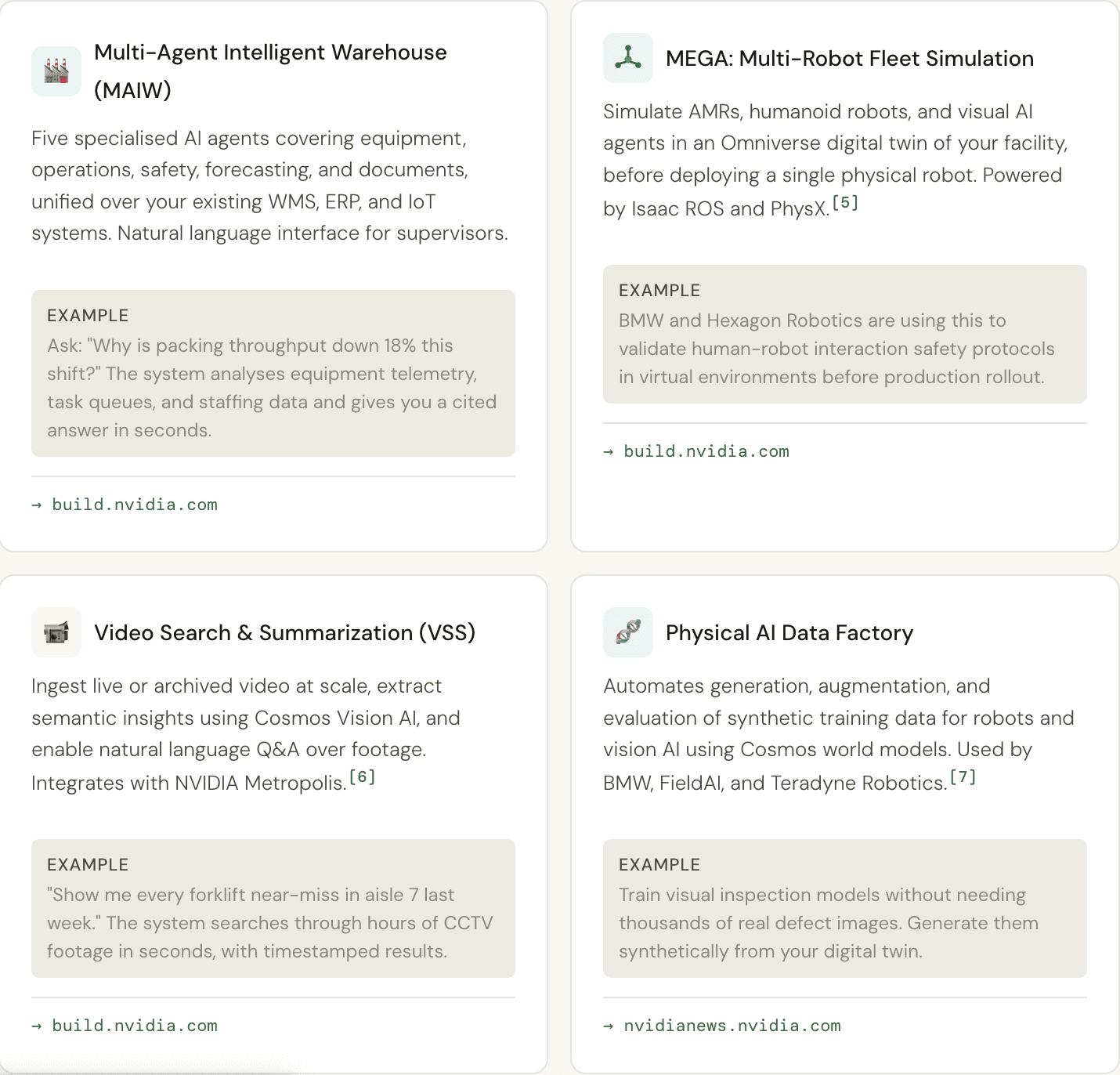
The Human-in-the-Loop Moment
Here's the part that I think gets glossed over in most technical coverage: none of these systems are designed to remove the human. The MAIW Blueprint, for example, uses NeMo Guardrails, a set of configurable rules that define what agents can and cannot do, who can see what, and when a decision must be escalated to a human operator.
This is the Industry 5.0 principle made concrete. The system handles the data volume and pattern recognition. The human handles judgment, authority, and accountability. The AI doesn't override the warehouse supervisor; it gives the supervisor information they could never have assembled themselves in time.
This balance between augmentation and replacement is also what makes the technology politically and organisationally viable in real industrial settings. Workers who fear job elimination will resist adoption. Workers who gain a powerful analytical assistant are more likely to engage.
What This Looks Like in Practice
Let me paint a concrete picture. Imagine a medium-sized automotive parts manufacturer. They have:
An ERP system (SAP) with years of production and maintenance history
IoT sensors on ~200 production assets
24 cameras across the facility
A team of 8 engineers who spend 30% of their time chasing down data across disconnected systems
With NVIDIA's stack, they deploy the MAIW Blueprint as their operations intelligence layer. NIM endpoints run on-premises, which is critical since the production floor cannot depend on a cloud connection. NeMo Customizer fine-tunes the LLM on their equipment manuals and maintenance codes. The VSS Blueprint indexes their camera feeds. The whole thing connects to SAP via the MCP tool layer.
Their engineers stop chasing data. They ask questions. The system answers with citations, confidence levels, and escalation flags when it does not know. That 30% data-chasing time redirects to engineering work.
This is not speculative. Accenture's AI Refinery for Industry, built on this exact stack, is already delivering outcomes like this across enterprise clients, with a commitment to 100+ industry-specific agent solutions built on NIM and NeMo.[8]
Honest Limitations
It would be dishonest to write this without acknowledging what's still hard.
Hallucination remains a real risk. AI agents can confidently produce wrong answers. In a factory setting, an incorrect maintenance recommendation is not just annoying. It can cause equipment damage or injury. NeMo Guardrails helps, but human oversight of critical decisions is non-negotiable, at least for now.
Data quality is the real unlock. These systems are only as good as the data they're grounded in. If your maintenance logs are inconsistent, your ERP data is messy, or your equipment naming conventions vary across sites, expect a painful data preparation phase before the agents become useful.
Organisational readiness takes longer than technical readiness. You can deploy a Blueprint in a day. Getting your team to trust it, establish governance for it, and build workflows around it takes months. The technology is the easy part.
Where to Start
If you want to explore hands-on, here's a practical progression:
Closing Thought
Industry 5.0 is a more nuanced vision than the hype suggests. It's not "AI runs the factory." It's "AI and humans run the factory together, and the system is designed so that the human's judgment always has the final word." That is actually a harder engineering problem than full automation, because it requires systems that are explainable, auditable, and defeatable.
NVIDIA's stack is the most complete production-grade answer I've seen to what that actually looks like in code and infrastructure. It is not perfect; nothing this new ever is. But it is real, it is open-source, and it is deployable today.
The factories of the next decade will not be run by AI or by humans. They'll be run by humans with AI that is genuinely useful. That's the promise. And it's closer than it looks.
References
Industry Research
Taylor & Francis / EJMBE: "Industry 5.0: Current Status and Future Directions" (2025)tandfonline.com/doi/full/10.1080/13602381.2025.2452877
arXiv:2511.18258: "Hybrid Agentic AI and Multi-Agent Systems in Smart Manufacturing" (Nov 2025)arxiv.org/abs/2511.18258
NVIDIA Documentation & Announcements
NVIDIA Technical Blog: "NIM Offers Optimized Inference Microservices for Deploying AI Models at Scale"developer.nvidia.com/blog/nvidia-nim-offers-optimized-inference...
NVIDIA Blog: "Agentic AI Blueprints" (CES 2025)blogs.nvidia.com/blog/agentic-ai-blueprints
NVIDIA: "Test Multi-Robot Fleets for Industrial Automation" Blueprint (Mega)build.nvidia.com/nvidia/mega-multi-robot-fleets-for-industrial-automation
NVIDIA: "Build a Video Search and Summarization Agent" Blueprintbuild.nvidia.com/nvidia/video-search-and-summarization
NVIDIA Newsroom: "Physical AI Data Factory Blueprint" (March 2026)nvidianews.nvidia.com/news/nvidia-announces-open-physical-ai-data-factory...
NVIDIA Blog: "Agentic AI Blueprints / Accenture AI Refinery for Industry" (2025)blogs.nvidia.com/blog/agentic-ai-blueprints
Further Reading
NVIDIA Blueprints Catalog (44 blueprints)build.nvidia.com/blueprints
All Blueprint source code on GitHubgithub.com/NVIDIA-AI-Blueprints
NVIDIA Isaac Developer Hub (Robotics & Physical AI)developer.nvidia.com/isaac